
Benchmarking Non-Invasive Speech BCIs: Lessons Learned from the 2025 PNPL Competition
Proceedings of Machine Learning Research (NeurIPS 2025 Competition Track) 2026
Abstract
We present a retrospective on the 2025 PNPL Competition, an open machine-learning benchmark for decoding speech from non-invasive brain recordings, which ran from June to September 2025 and culminated in a workshop at NeurIPS that December. The competition used the LibriBrain dataset—over 50 hours of within-subject MEG with standard data splits—and challenged participants to tackle two tasks: Speech Detection (binary frame-level classification) and Phoneme Classification (39-class ARPAbet prediction). Across 155 registered teams and 6,041 submissions, top F1-macro scores reached 95.6% for Speech Detection and 73.6% for Phoneme Classification, exceeding prior baselines of 68% and 44%, respectively, by wide margins. High-performing submissions converged on a common architectural template—temporal CNN or TCN backbones with task-specific recurrent or attention-based heads—whilst task-specific strategies such as temporal smoothing and ensemble voting proved critical for competitive performance. Hidden track evaluations suggest that main-track Speech Detection models generalised poorly to balanced class distributions. This could imply a reliance on class priors rather than robust neural decoding, highlighting a useful lesson: evaluation distributions should reflect intended deployment conditions. We further reflect on design choices, organisational lessons, and plans for future competitions in this series.
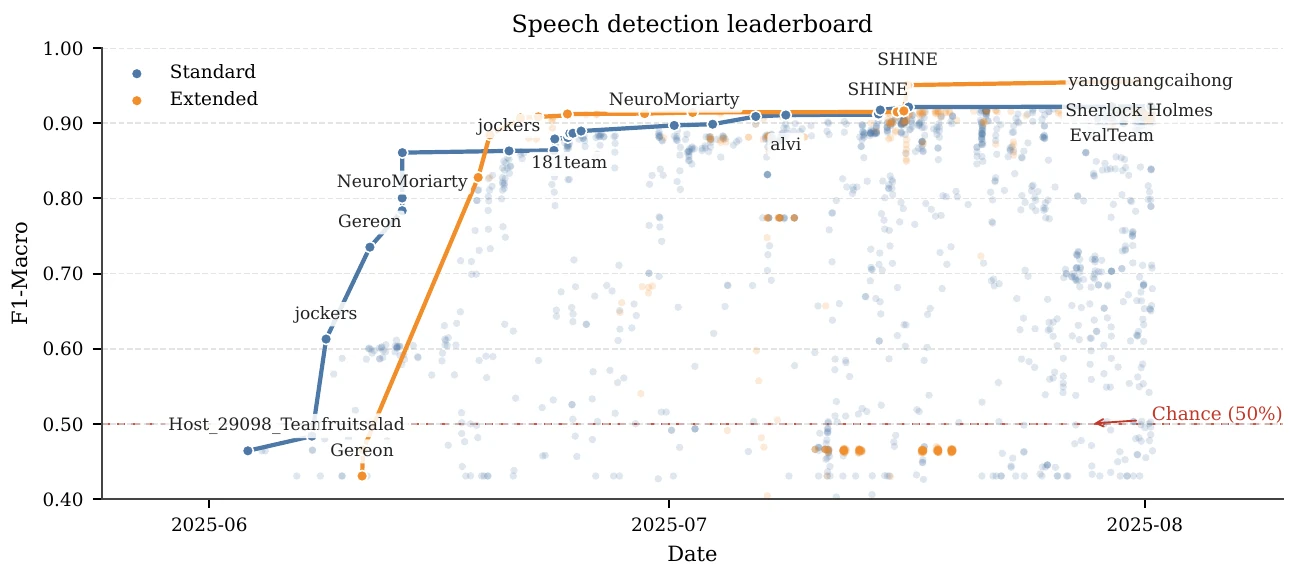
Speech detection competition progress. Figure 1 from the competition retrospective shows Phase 1 public-leaderboard F1-macro scores. These submission trajectories are distinct from the final held-out rankings reported in the paper.
© 2026 Elvers, Landau, Mantegna et al. · Official competition retrospective, Figure 1, PDF page 3. Resized; full frame preserved.
View full-size figure