
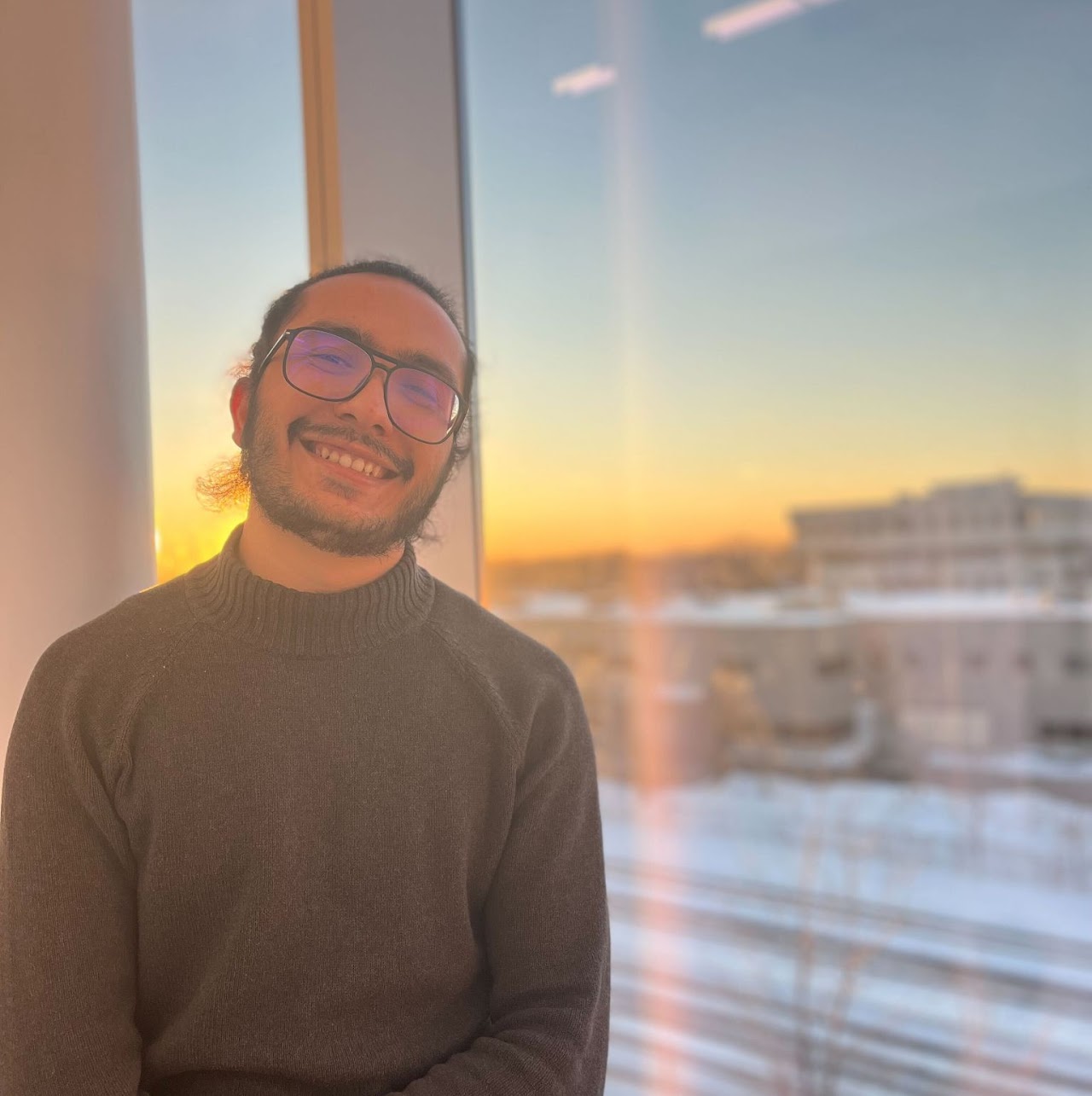
Sfax Tiohtià:ke / Montréal
About Hamza Abdelhedi
I am a PhD student in Biomedical Engineering at Université de Montréal, working with CoCo Lab and Mila. My path here began in Sfax, Tunisia, and continues in Tiohtià:ke / Montréal.
I began with mathematics and physics, then completed an Engineering Diploma in Telecommunications — Smart Imaging Applications at Higher School of Communication of Tunis. During my engineering research internship, I explored how human brains and artificial neural networks represent faces. That bridge between engineering and neuroscience brought me to an MSc in Computer Science — Artificial Intelligence and, eventually, the questions I study now.
Why Neuro-AI?
What drew me in was the chance to use computational tools to ask questions about the brain, and to let what we learn about brains challenge how we think about artificial systems. In my earlier face-familiarity research, I studied how neural representations change over time as we recognize familiar and unfamiliar faces.
My research connects neural dynamics and cognition, representations in brains and AI, and computational methods for M/EEG. Magnetoencephalography and electroencephalography let me study how brain activity unfolds over time, while computational models help me investigate how it supports behavior and what it represents.
Within these directions, my PhD asks how changing sensory evidence becomes a decision and an action. In collaborative work at CHU Sainte-Justine, I study pediatric clinical EEG questions about ADHD and epilepsy, comparing signal features with learned representations.
I build and contribute to open-source neuroscience software because a method becomes more useful when others can inspect it, adapt it, and build on it. Sharing tools and sharing knowledge are both part of how I want to do research.
Values and responsibility
I am deeply committed to contributing to society by focusing on ethics, equity, diversity, and inclusion in science. I raise awareness about the socio-environmental risks and potential dangers of the scientific tools we develop.
A fan of open & accessible science, I want to build shareable tools that lower research barriers and help foster fairness and equity within the scientific community.
I try to stand with people who are marginalized, minoritized, underrepresented, or excluded in science and society, and to help make scientific spaces and resources more accessible.
Making the world a better place is our collective responsibility to each other and to the planet.
Teaching, mentoring, and community
I firmly believe that science belongs to everyone. I enjoy sharing knowledge through teaching and mentoring, from cognitive-neuroscience courses at Université de Montréal and Indigenous Pathfinders in AI to graduate and undergraduate research projects. At the MAIN 2024 educational sessions, I led a hands-on tutorial on representational similarity analysis with MEG data; the tutorial materials are available to reuse.
As a founding member of TuNA, Tunisians in Neuroscience and AI, I help connect people across the fields that shaped my own path. With Abundant Intelligences, I have contributed to research and taught hands-on AI sessions in the Future Imaginaries workshop series. I have also helped organize discussions about the societal impacts and responsible use of AI.
Explore my community and service roles, from student leadership in Tunisia to scientific gatherings in Montréal, and my teaching and research mentoring.
Selected awards & training
-
2026
Simons Computational Neuroscience Imbizo — Full Scholarship
Selected scholar for intensive computational neuroscience training in Cape Town, South Africa.
-
2025
UNIQUE Excellence Scholarship, PhD level
Competitive merit-based research scholarship.
-
2024–2027
Merit Scholarship, AI Research Fund
Support for my AI research at Université de Montréal.
Rejections and Failures
Failures and rejections are often seen as a negative aspect of life. However, I see them as an essential part of the learning process—they are the stepping stones that forge resilience.
Land acknowledgment
My acknowledgment of Tiohtià:ke / Montréal
Tiohtià:ke/Montréal is on unceded Indigenous lands. I recognize the Kanien'kehá:ka Nation as the custodians of the lands and waters on which I live and work. During the years I have lived in Montréal, I have come to embrace it as my home and am learning about the rich history of the land and the peoples who have lived here for thousands of years. I extend my deep gratitude to them, celebrate the beauty and diversity of this land, and reaffirm my commitment to truth and reconciliation.
Education and research roles
The records below include degrees, employment, and collaborations; some took place during the same period. For a formal account, see my CV.
-
Jan 2025–Present

Research Collaborator
Le Centre hospitalier universitaire Sainte-Justine
Collaborating with Dr. Alexander G. Weil and Dr. Aristides Hadjinicolaou on clinical EEG research.
-
Sep 2024–Present
PhD in Biomedical Engineering
Université de Montréal
Supervisor: Prof. Karim Jerbi. Research affiliations: CoCo Lab and Mila.
-
2024–Present
AI Lab Member / Research Contributor
Abundant Intelligences
Abundant Intelligences; part-time since March 2026.
-
Sep 2024–Present

Graduate Research Assistant
MILA - Quebec Artificial Intelligence institute
Cognitive & Computational Neuroscience Lab (CoCo Lab) and Mila; supervisor: Prof. Karim Jerbi.
-
Sep 2022–Aug 2024
MSc in Computer Science — Artificial Intelligence
Université de Montréal
Supervisor: Prof. Karim Jerbi; co-supervisor: Prof. Shahab Bakhtiari. Research affiliations: CoCo Lab and Mila.
-
Sep 2022–Aug 2024
Graduate Research Assistant
Systems Neuroscience and AI Lab
CoCo Lab, Systems Neuroscience and AI Lab (SNAILab), and Mila; MSc research on face familiarity.
-
Sep 2018–Oct 2021
Engineering Diploma in Telecommunications — Smart Imaging Applications
Higher School of Communication of Tunis
University of Carthage — Higher School of Communication of Tunis (SUP'COM).