
Resting-state neural oscillations predict individual differences in verbal learning and encoding strategy use
iScience 2026
Abstract
Individuals adopt different encoding strategies to facilitate learning, yet few studies have examined the neurophysiological basis of these strategies across individuals. The present work addresses this gap by extending our previous findings on the direct relationship between cortical spectral power, measured via resting-state magnetoencephalography, and standard cognitive performance, to test whether resting-state neural features predict individual differences in encoding strategy preferences.
Our results highlight the complex interactions between endogenous brain oscillations, learning, and verbal encoding strategies assessed by the California Verbal Learning Test-Second Edition (CVLT-2). First, resting-state theta oscillations were significantly associated with verbal learning and subjective clustering strategies. Second, semantic clustering was facilitated by oscillatory patterns in the left sensory-motor regions.
Finally, serial and semantic clustering strategies showed opposite regression patterns, indicating a competitive interaction. Together, these findings provide insights into resting-state neural markers associated with diverse encoding strategies in verbal learning.
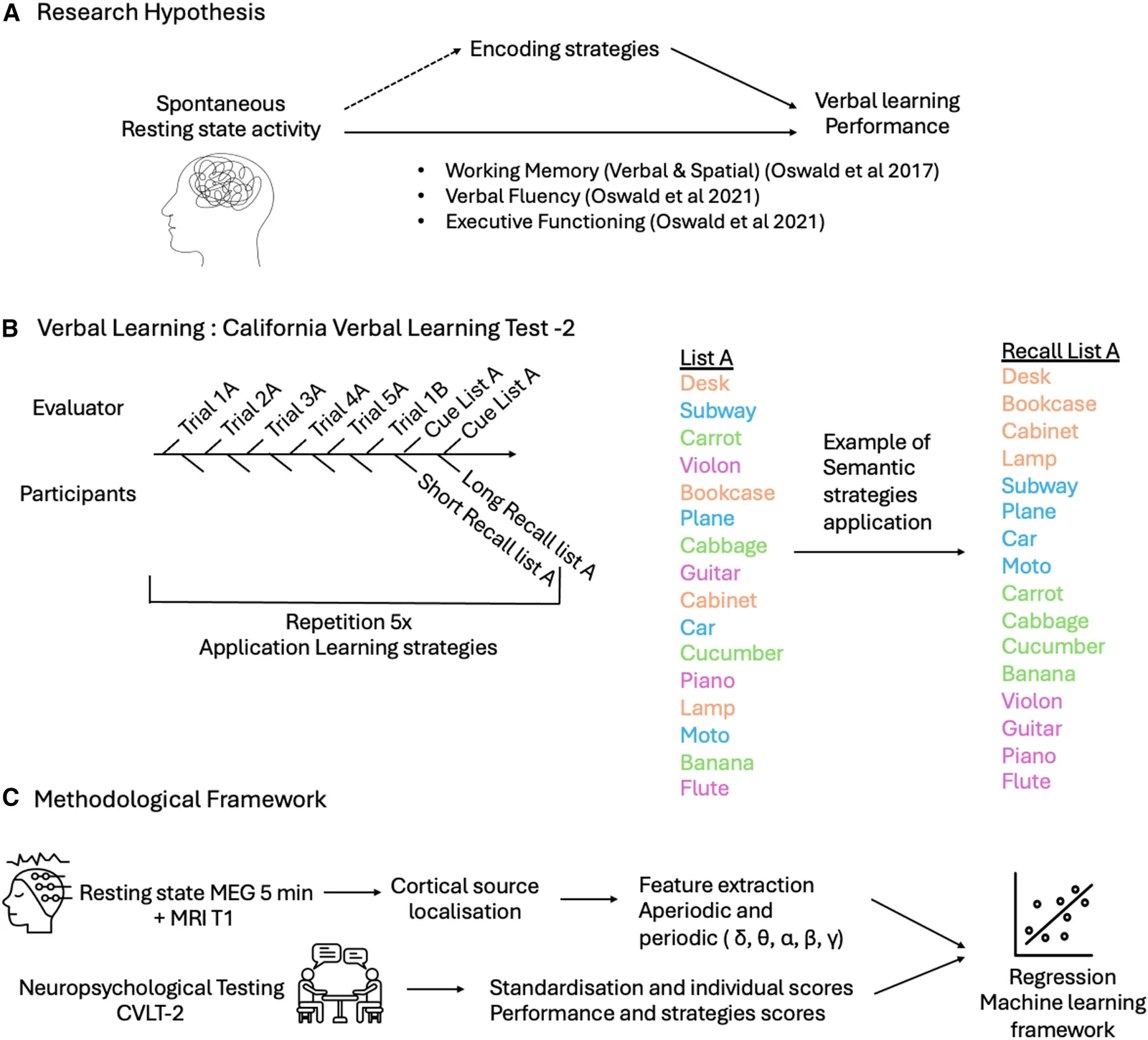
Connecting resting brain activity with verbal learning. The study framework brings together resting-state MEG and a verbal learning assessment. Panel A introduces the hypothesis, panel B illustrates the word-list task and semantic grouping, and panel C outlines how brain features and cognitive scores enter the regression analysis.
Oswald et al. (2026) · Paper Figure 1 · CC BY-NC 4.0. Resized; full frame preserved.
View full-size figure