
Linking human and artificial neural representations underlying face recognition: Insights from MEG and CNNs
Conference on Cognitive Computational Neuroscience 2022
Abstract
Mounting evidence suggests that biological and artificial neural networks trained on similar tasks can exhibit remarkable functional similarities. In particular, Convolutional Neural Networks (CNNs) trained on object recognition have been shown to learn representations that model the processing hierarchy in the human visual system. But what about the specific case of face recognition? Would CNNs trained on face recognition learn representations that capture the neural dynamics of the neural circuits that mediate face recognition? Here, we investigated the putative similarities between the representations learned by three CNN architectures trained on face recognition (FaceNet, ResNet50 and CORnet-S) and brain patterns assessed with magnetoencephalography (MEG) recorded during a face recognition task. We found that the neuromagnetic brain signals (especially in visual areas) were correlated with activations in multiple CNN layers. However, these correlations were not as strong as those observed in the more general task of object recognition. This may suggest that CNNs trained on face recognition capture only a small portion of the complexity of the real brain patterns associated with face recognition. Our results contribute to an emerging stream of research that seeks to probe face recognition mechanisms by joint exploration of the associated neural representations in both brains and machines.
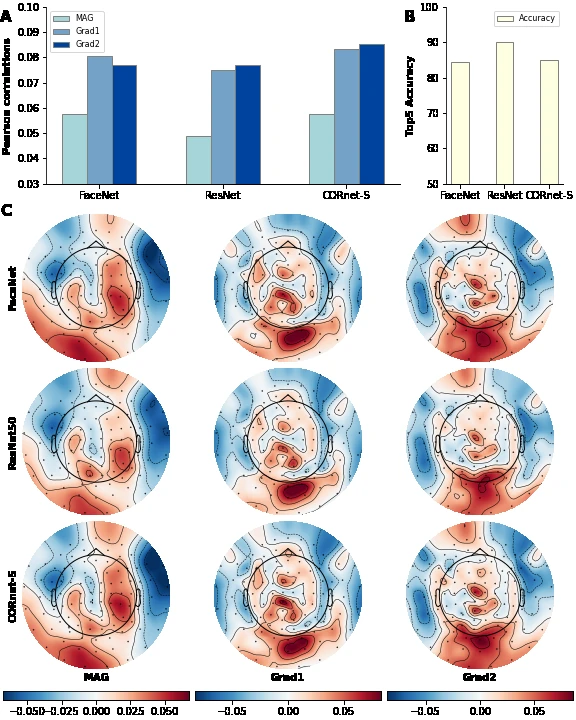
Face recognition representations in MEG and CNNs. Figure 1 from the CCN 2022 paper compares FaceNet, ResNet50 and CORnet-S with MEG representations. The complete figure retains all sensor maps, axes and color scales.
Abdelhedi and Jerbi (2022) · CCN 2022, Figure 1, PDF page 3 · CC BY 3.0. Resized; full frame preserved.
View full-size figure